
Rotori a flusso continuo
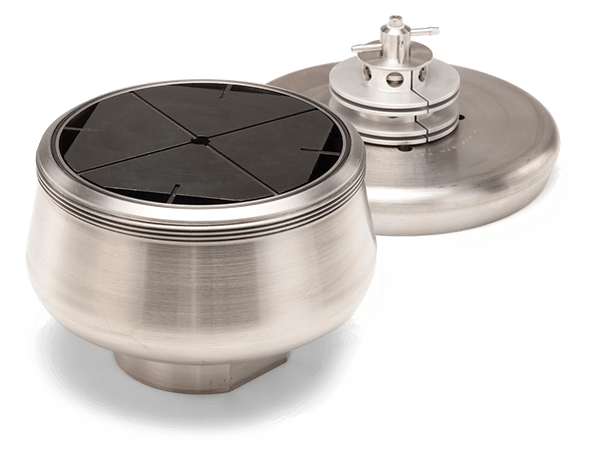
Un rotore a flusso continuo permette di centrifugare grandi volumi di materiale ad alte forze centrifughe senza bisogno di riempire e travasare molte provette da centrifuga, o di avviare e fermare frequentemente il rotore. Quando si usa questo rotore, si raccoglie un surnatante o si recupera un pellet. I rotori a flusso continuo riducono sostanzialmente il tempo di lavorazione del materiale per 2 motivi:
- Hanno lunghezze di percorso brevi per ridurre il tempo complessivo di pellettizzazione. Quindi, pellettizzano in modo efficiente i solidi di un campione e facilitano un flusso rapido di materiale attraverso il rotore.
- Hanno grandi capienze. Pertanto, non hanno bisogno di essere avviati e fermati così spesso come i rotori convenzionali. Ciò consente di risparmiare tempo riducendo la manipolazione del campione e riducendo il tempo perso nell'attesa dell'accelerazione/decelerazione del rotore tra le corse.
Le principali applicazioni per i rotori a flusso continuo includono: grandi virus, mitocondri, omogenati di tessuto, batteri, raccolta di cellule e raccolta di alghe. Il rotore a flusso continuo è particolarmente indicato se:
- Il coefficiente di sedimentazione delle particelle da raccogliere è superiore a 50 S. Poiché il rotore ha un'alta efficienza di pellettizzazione, il materiale solido può essere separato dal mezzo liquido più velocemente che con un rotore a braccio oscillante o un rotore ad angolo fisso.
- Il rapporto solido/liquido del campione è basso (5-15%). Al di sopra di un rapporto solido/liquido del 15%, il rotore tende ad essere troppo efficiente, vale a dire, si sbriciola così rapidamente che si riempie immediatamente. Questo significa che deve essere fermato per scaricare i pellet così spesso che si perde troppo tempo per accelerare/decelerare il rotore e pulirlo tra una corsa e l'altra. Al contrario, se il campione contiene poco materiale solido, il rotore funzionerà per lunghi periodi di tempo, elaborando grandi volumi di materiale tra gli arresti.
Clicca qui per vedere come funziona il nuovo calcolatore Intellifuge.
FAQ Continuous Flow Centrifuge Rotors
What types of samples can be processed with continuous flow rotors?
Continuous flow rotors can be used for cell cultures, microbial suspensions, viral preparations, fermentation broths, tissue homogenates and other biological samples that require large-volume processing and particle recovery.
Why are continuous flow rotors used for large-scale centrifugation?
Continuous flow rotors help eliminate many of the inefficiencies associated with repeated batch processing. By allowing continuous sample loading and processing, they can significantly improve throughput when handling large sample volumes.
How does a continuous flow centrifuge work?
In a continuous flow centrifuge, the sample is continuously fed into the spinning rotor while clarified liquid exits the system. Particles with sufficient sedimentation properties are retained and concentrated within the rotor, allowing large sample volumes to be processed efficiently.
Why are continuous flow rotors advantageous for dilute samples?
Samples with low solid concentrations allow the rotor to operate for extended periods before unloading is required. This enables continuous processing of large volumes, making the workflow more efficient and reducing downtime.
When should a continuous flow rotor be used?
A continuous flow rotor is best suited for processing large sample volumes that contain relatively low concentrations of solid particles. It is particularly effective when the particles have a sedimentation coefficient greater than 50 S, allowing rapid and efficient separation.
What happens if the solid concentration exceeds 15%?
When the solid-to-liquid ratio is above 15%, pellet formation can occur too quickly, causing the rotor to fill rapidly. This requires frequent stops for pellet removal and cleaning, reducing overall process efficiency due to repeated acceleration and deceleration cycles.
What are the advantages of continuous flow centrifugation?
Continuous flow centrifugation can reduce sample handling, improve throughput, minimize downtime between runs and support efficient processing of large-volume samples. These advantages make continuous flow rotors valuable for scale-up and production-oriented centrifugation workflows.
What is the difference between a continuous flow rotor and a standard centrifuge rotor?
Standard centrifuge rotors process samples in discrete batches using individual tubes or bottles. Continuous flow rotors allow material to be processed continuously while the rotor remains in operation, making them better suited for large-scale centrifugation and high-throughput workflows.
Why is a continuous flow rotor recommended for particles with a sedimentation coefficient above 50 S?
Continuous flow rotors have very high pelleting efficiency. For particles with sedimentation coefficients greater than 50 S, they can separate solids from liquids more quickly than fixed-angle or swinging-bucket rotors, improving throughput and reducing processing time.
What is a continuous flow rotor?
A continuous flow rotor is a centrifuge rotor that allows samples to be continuously introduced and processed while the rotor remains in operation. This design enables efficient processing of large sample volumes without the need for repeated centrifuge tube loading and unloading.
What applications are continuous flow rotors commonly used for?
Continuous flow rotors are commonly used for large-scale cell harvesting, bacterial and yeast culture processing, virus purification, cell culture clarification, and concentration of biological particles from large liquid volumes.
What is the ideal solid-to-liquid ratio for a continuous flow rotor?
A continuous flow rotor performs best when the sample contains approximately 5% to 15% solids. Within this range, the rotor can process large volumes efficiently without requiring frequent interruptions.
