
Rotori fissi verticali
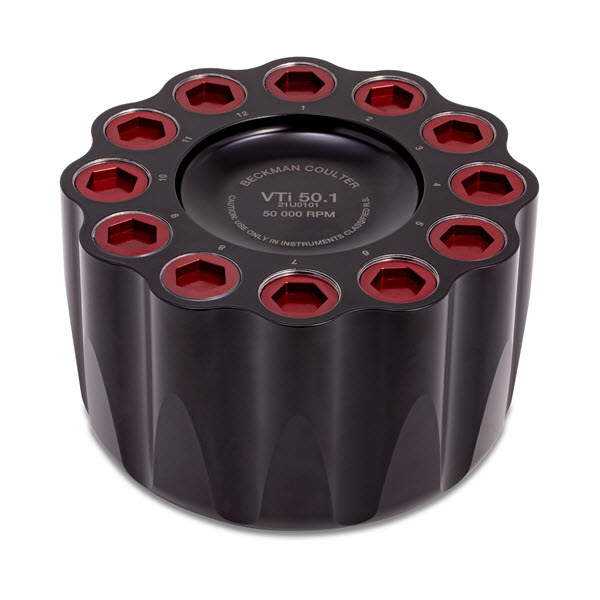
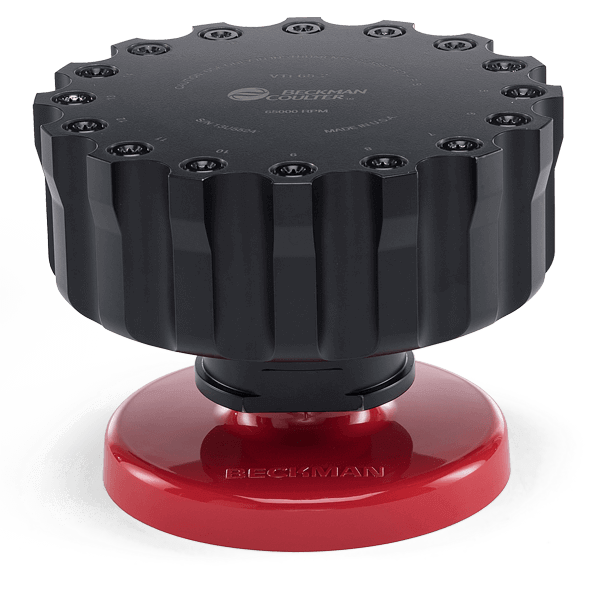
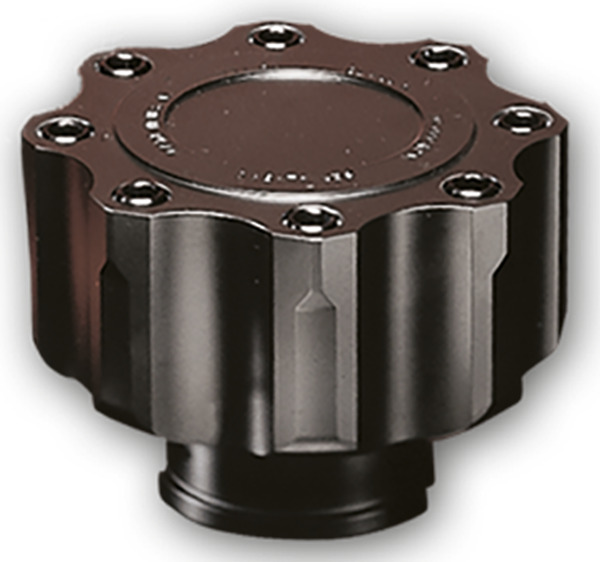
I rotori ad angolo verticale presentano la lunghezza del percorso più breve di qualsiasi tipo di rotore, il tempo di esecuzione più veloce e la risoluzione più alta.
In un rotore verticale, i tubi sono verticali durante la corsa. La breve lunghezza del percorso e i bassi fattori k di questi rotori significano che la particella ha solo una breve distanza da percorrere per essere pellettizzata, riducendo il tempo di esecuzione dell'applicazione.
Non è il miglior rotore da usare per la pellettizzazione, perché la forza centripeta in un tubo perfettamente verticale diffonde il pellet lungo l'intera parete esterna del tubo.
Un rotore verticale è usato per
- Separazioni isopicliche - in particolare per la formazione di bande di DNA nel cloruro di cesio
- Separazioni a gradiente e a cuscino di densità, come per le particelle virali
Una separazione a gradiente a cuscino di densità:
- Strati a densità crescente che terminano con un cuscino a densità maggiore sul fondo della provetta
- Ideale per l'isolamento di campioni in pellet e lagili all'interfaccia del cuscino più "morbido".
Clicca qui per scoprire come funziona il nuovo calcolatore Intellifuge

FAQ on Vertical Angle Rotors
What applications are vertical rotors commonly used for?
Vertical rotors are commonly used for isopycnic centrifugation, density gradient separations, plasmid DNA purification, viral particle isolation, lipoprotein analysis and other ultracentrifugation workflows that require rapid equilibrium separations.
What is a vertical rotor?
A vertical rotor is an ultracentrifuge rotor that maintains sample tubes parallel to the axis of rotation during centrifugation. This geometry creates the shortest sedimentation path of any rotor design and helps accelerate density gradient separations.
Why are vertical rotors used for isopycnic centrifugation?
Vertical rotors provide a very short path length through the density gradient. This allows particles to migrate quickly to their equilibrium density, helping reduce run times while maintaining high separation resolution.
What is the k-factor of a centrifuge rotor?
The k-factor is a measure of a rotor's sedimentation efficiency. Lower k-factor values generally indicate faster particle sedimentation and shorter run times. When comparing ultracentrifuge rotors, the k-factor can help determine which rotor may provide the most efficient separation for a specific application.
Are vertical rotors suitable for pelleting applications?
Vertical rotors are generally not the preferred choice for pelleting. Because the tubes remain vertical during centrifugation, pellets may spread along the outer wall of the tube rather than forming a compact pellet at the bottom. Fixed-angle or swinging-bucket rotors are typically better suited for pelleting workflows.
What is the difference between a vertical rotor and a fixed-angle rotor?
Vertical rotors are primarily designed for density gradient and isopycnic separations, where particles move through a gradient to reach their equilibrium density. Fixed-angle rotors are typically optimized for pelleting applications, where particles sediment toward the tube wall and form a pellet. The choice depends on whether the goal is particle pelleting or high-resolution gradient separation.
When should I use a near vertical rotor instead of a vertical rotor?
Use a near vertical rotor instead of a vertical rotor if particles in your solution will pellet out of solution and risk contaminating your gradient bands. In a near vertical rotor, those containments will move to the bottom of the tube instead of remain on the side wall, as they do in a vertical rotor.
